The templates defined herein facilitate sharing the relation arithmetic between the prover and the verifier. More...
#include <relation_types.hpp>
Static Public Attributes | |
| static constexpr std::array< size_t, RelationImpl::SUBRELATION_PARTIAL_LENGTHS.size()> | SUBRELATION_TOTAL_LENGTHS |
| static constexpr size_t | RELATION_LENGTH |
| static constexpr size_t | TOTAL_RELATION_LENGTH |
Detailed Description
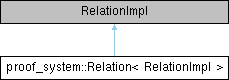
class proof_system::Relation< RelationImpl >
The templates defined herein facilitate sharing the relation arithmetic between the prover and the verifier.
The sumcheck prover and verifier accumulate the contributions from each relation (really, each sub-relation) into, respectively, Univariates and individual field elements. When performing relation arithmetic on Univariates, we introduce UnivariateViews to reduce full length Univariates to the minimum required length and to avoid unnecessary copies.
To share the relation arithmetic, we introduce simple structs that specify two types: Accumulators and AccumulatorViews. For the prover, who accumulates Univariates, these are respectively std::tuple<Univariate> and std::tuple<UnivariateView>. For the verifier, who accumulates FFs, both types are simply aliases for std::array<FF> (since no "view" type is necessary). The containers std::tuple and std::array are needed to accommodate multiple sub-relations within each relation, where, for efficiency, each sub-relation has its own specified degree.
- Note
- We use some funny terminology: we use the term "length" for 1 + the degree of a relation. When the relation is regarded as a polynomial in all of its arguments, we refer to this length as the "total length", and when we hold the relation parameters constant we refer to it as a "partial length."
A wrapper for Relations to expose methods used by the Sumcheck prover or verifier to add the contribution of a given relation to the corresponding accumulator.
- Template Parameters
-
FF RelationImpl Base class that implements the arithmetic for a given relation (or set of sub-relations)
Member Data Documentation
◆ RELATION_LENGTH
|
staticconstexpr |
◆ SUBRELATION_TOTAL_LENGTHS
|
staticconstexpr |
◆ TOTAL_RELATION_LENGTH
|
staticconstexpr |
The documentation for this class was generated from the following file:
- src/barretenberg/relations/relation_types.hpp