Classes | |
| struct | cached_partial_non_native_field_multiplication |
| Used to store instructions to create partial_non_native_field_multiplication gates. We want to cache these (and remove duplicates) as the stdlib code can end up multiplying the same inputs repeatedly. More... | |
| struct | CircuitDataBackup |
| CircuitDataBackup is a structure we use to store all the information about the circuit that is needed to restore it back to a pre-finalized state. More... | |
| struct | non_native_field_multiplication_cross_terms |
| struct | RamRecord |
| A RAM memory record that can be ordered. More... | |
| struct | RamTranscript |
| Each ram array is an instance of memory transcript. It saves values and indexes for a particular memory array. More... | |
| struct | RangeList |
| struct | RomRecord |
| A ROM memory record that can be ordered. More... | |
| struct | RomTranscript |
| Each rom array is an instance of memory transcript. It saves values and indexes for a particular memory array. More... | |
Public Types | |
| enum | AUX_SELECTORS { NONE , LIMB_ACCUMULATE_1 , LIMB_ACCUMULATE_2 , NON_NATIVE_FIELD_1 , NON_NATIVE_FIELD_2 , NON_NATIVE_FIELD_3 , RAM_CONSISTENCY_CHECK , ROM_CONSISTENCY_CHECK , RAM_TIMESTAMP_CHECK , ROM_READ , RAM_READ , RAM_WRITE } |
| using | FF = typename Arithmetization::FF |
| using | WireVector = std::vector< uint32_t, ContainerSlabAllocator< uint32_t > > |
| using | SelectorVector = std::vector< FF, ContainerSlabAllocator< FF > > |
| typedef std::pair< uint32_t, FF > | scaled_witness |
| typedef std::tuple< scaled_witness, scaled_witness, FF > | add_simple |
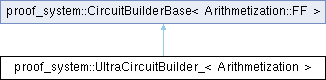
 Public Types inherited from proof_system::CircuitBuilderBase< Arithmetization::FF > Public Types inherited from proof_system::CircuitBuilderBase< Arithmetization::FF > | |
| using | FF = Arithmetization::FF |
| using | EmbeddedCurve = std::conditional_t< std::same_as< FF, barretenberg::g1::coordinate_field >, curve::BN254, curve::Grumpkin > |
Public Member Functions | |
| WireVector & | w_l () |
| WireVector & | w_r () |
| WireVector & | w_o () |
| WireVector & | w_4 () |
| const WireVector & | w_l () const |
| const WireVector & | w_r () const |
| const WireVector & | w_o () const |
| const WireVector & | w_4 () const |
| SelectorVector & | q_m () |
| SelectorVector & | q_c () |
| SelectorVector & | q_1 () |
| SelectorVector & | q_2 () |
| SelectorVector & | q_3 () |
| SelectorVector & | q_4 () |
| SelectorVector & | q_arith () |
| SelectorVector & | q_sort () |
| SelectorVector & | q_elliptic () |
| SelectorVector & | q_aux () |
| SelectorVector & | q_lookup_type () |
| const SelectorVector & | q_c () const |
| const SelectorVector & | q_1 () const |
| const SelectorVector & | q_2 () const |
| const SelectorVector & | q_3 () const |
| const SelectorVector & | q_4 () const |
| const SelectorVector & | q_arith () const |
| const SelectorVector & | q_sort () const |
| const SelectorVector & | q_elliptic () const |
| const SelectorVector & | q_aux () const |
| const SelectorVector & | q_lookup_type () const |
| const SelectorVector & | q_m () const |
| void | process_non_native_field_multiplications () |
Called in compute_proving_key when finalizing circuit. Iterates over the cached_non_native_field_multiplication objects, removes duplicates, and instantiates the remainder as constraints`. | |
| UltraCircuitBuilder_ (const size_t size_hint=0) | |
| UltraCircuitBuilder_ (const UltraCircuitBuilder_ &other)=default | |
| UltraCircuitBuilder_ (UltraCircuitBuilder_ &&other) | |
| UltraCircuitBuilder_ & | operator= (const UltraCircuitBuilder_ &other)=default |
| UltraCircuitBuilder_ & | operator= (UltraCircuitBuilder_ &&other) |
| void | check_selector_length_consistency () |
| Debug helper method for ensuring all selectors have the same size. | |
| void | finalize_circuit () |
| void | add_gates_to_ensure_all_polys_are_non_zero () |
| Ensure all polynomials have at least one non-zero coefficient to avoid commiting to the zero-polynomial. | |
| void | create_add_gate (const add_triple_< FF > &in) override |
| Create an addition gate, where in.a * in.a_scaling + in.b * in.b_scaling + in.c * in.c_scaling + in.const_scaling = 0. | |
| void | create_big_add_gate (const add_quad_< FF > &in, const bool use_next_gate_w_4=false) |
| Create a big addition gate, where in.a * in.a_scaling + in.b * in.b_scaling + in.c * in.c_scaling + in.d * in.d_scaling + in.const_scaling = 0. If include_next_gate_w_4 is enabled, then thes sum also adds the value of the 4-th witness at the next index. | |
| void | create_big_add_gate_with_bit_extraction (const add_quad_< FF > &in) |
| A legacy method that was used to extract a bit from c-4d by using gate selectors in the Turboplonk, but is simulated here for ultraplonk. | |
| void | create_big_mul_gate (const mul_quad_< FF > &in) |
| Create a basic multiplication gate q_m * a * b + q_1 * a + q_2 * b + q_3 * c + q_4 * d + q_c = 0 (q_arith = 1) | |
| void | create_balanced_add_gate (const add_quad_< FF > &in) |
| void | create_mul_gate (const mul_triple_< FF > &in) override |
| Create a multiplication gate with q_m * a * b + q_3 * c + q_const = 0. | |
| void | create_bool_gate (const uint32_t a) override |
| Generate an arithmetic gate equivalent to x^2 - x = 0, which forces x to be 0 or 1. | |
| void | create_poly_gate (const poly_triple_< FF > &in) override |
| A plonk gate with disabled (set to zero) fourth wire. q_m * a * b + q_1 * a + q_2 * b + q_3. | |
| void | create_ecc_add_gate (const ecc_add_gate_< FF > &in) |
| Create an elliptic curve addition gate. | |
| void | create_ecc_dbl_gate (const ecc_dbl_gate_< FF > &in) |
| Create an elliptic curve doubling gate. | |
| void | fix_witness (const uint32_t witness_index, const FF &witness_value) |
| Add a gate equating a particular witness to a constant, fixing it the value. | |
| void | create_new_range_constraint (const uint32_t variable_index, const uint64_t target_range, std::string const msg="create_new_range_constraint") |
| Constrain a variable to a range. | |
| void | create_range_constraint (const uint32_t variable_index, const size_t num_bits, std::string const &msg) |
| accumulator_triple_< FF > | create_logic_constraint (const uint32_t a, const uint32_t b, const size_t num_bits, bool is_xor_gate) |
| accumulator_triple_< FF > | create_and_constraint (const uint32_t a, const uint32_t b, const size_t num_bits) |
| accumulator_triple_< FF > | create_xor_constraint (const uint32_t a, const uint32_t b, const size_t num_bits) |
| uint32_t | put_constant_variable (const FF &variable) |
| size_t | get_num_constant_gates () const override |
| void | get_num_gates_split_into_components (size_t &count, size_t &rangecount, size_t &romcount, size_t &ramcount, size_t &nnfcount) const |
| Get the final number of gates in a circuit, which consists of the sum of: 1) Current number number of actual gates 2) Number of public inputs, as we'll need to add a gate for each of them 3) Number of Rom array-associated gates 4) Number of range-list associated gates 5) Number of non-native field multiplication gates. | |
| size_t | get_num_gates () const override |
| Get the final number of gates in a circuit, which consists of the sum of: 1) Current number number of actual gates 2) Number of public inputs, as we'll need to add a gate for each of them 3) Number of Rom array-associated gates 4) Number of range-list associated gates 5) Number of non-native field multiplication gates. | |
| size_t | get_total_circuit_size () const |
| Get the size of the circuit if it was finalized now. | |
| virtual void | print_num_gates () const override |
| Print the number and composition of gates in the circuit. | |
| void | assert_equal_constant (const uint32_t a_idx, const FF &b, std::string const &msg="assert equal constant") |
| void | add_table_column_selector_poly_to_proving_key (barretenberg::polynomial &small, const std::string &tag) |
| void | initialize_precomputed_table (const plookup::BasicTableId id, bool(*generator)(std::vector< FF > &, std::vector< FF > &, std::vector< FF > &), std::array< FF, 2 >(*get_values_from_key)(const std::array< uint64_t, 2 >)) |
| plookup::BasicTable & | get_table (const plookup::BasicTableId id) |
| plookup::MultiTable & | create_table (const plookup::MultiTableId id) |
| plookup::ReadData< uint32_t > | create_gates_from_plookup_accumulators (const plookup::MultiTableId &id, const plookup::ReadData< FF > &read_values, const uint32_t key_a_index, std::optional< uint32_t > key_b_index=std::nullopt) |
| Perform a series of lookups, one for each 'row' in read_values. | |
| std::vector< uint32_t > | decompose_into_default_range (const uint32_t variable_index, const uint64_t num_bits, const uint64_t target_range_bitnum=DEFAULT_PLOOKUP_RANGE_BITNUM, std::string const &msg="decompose_into_default_range") |
| std::vector< uint32_t > | decompose_into_default_range_better_for_oddlimbnum (const uint32_t variable_index, const size_t num_bits, std::string const &msg="decompose_into_default_range_better_for_oddlimbnum") |
| void | create_dummy_constraints (const std::vector< uint32_t > &variable_index) |
| void | create_sort_constraint (const std::vector< uint32_t > &variable_index) |
| void | create_sort_constraint_with_edges (const std::vector< uint32_t > &variable_index, const FF &, const FF &) |
| void | assign_tag (const uint32_t variable_index, const uint32_t tag) |
| uint32_t | create_tag (const uint32_t tag_index, const uint32_t tau_index) |
| uint32_t | get_new_tag () |
| RangeList | create_range_list (const uint64_t target_range) |
| void | process_range_list (RangeList &list) |
| void | process_range_lists () |
| void | apply_aux_selectors (const AUX_SELECTORS type) |
| Enable the auxilary gate of particular type. | |
| void | range_constrain_two_limbs (const uint32_t lo_idx, const uint32_t hi_idx, const size_t lo_limb_bits=DEFAULT_NON_NATIVE_FIELD_LIMB_BITS, const size_t hi_limb_bits=DEFAULT_NON_NATIVE_FIELD_LIMB_BITS) |
| std::array< uint32_t, 2 > | decompose_non_native_field_double_width_limb (const uint32_t limb_idx, const size_t num_limb_bits=(2 *DEFAULT_NON_NATIVE_FIELD_LIMB_BITS)) |
| Decompose a single witness into two, where the lowest is DEFAULT_NON_NATIVE_FIELD_LIMB_BITS (68) range constrained and the lowst is num_limb_bits - DEFAULT.. range constrained. | |
| std::array< uint32_t, 2 > | evaluate_non_native_field_multiplication (const non_native_field_witnesses< FF > &input, const bool range_constrain_quotient_and_remainder=true) |
| Queue up non-native field multiplication data. | |
| std::array< uint32_t, 2 > | queue_partial_non_native_field_multiplication (const non_native_field_witnesses< FF > &input) |
| std::array< uint32_t, 5 > | evaluate_non_native_field_subtraction (add_simple limb0, add_simple limb1, add_simple limb2, add_simple limb3, std::tuple< uint32_t, uint32_t, FF > limbp) |
| std::array< uint32_t, 5 > | evaluate_non_native_field_addition (add_simple limb0, add_simple limb1, add_simple limb2, add_simple limb3, std::tuple< uint32_t, uint32_t, FF > limbp) |
| size_t | create_ROM_array (const size_t array_size) |
| Create a new read-only memory region. | |
| void | set_ROM_element (const size_t rom_id, const size_t index_value, const uint32_t value_witness) |
Initialize a rom cell to equal value_witness | |
| void | set_ROM_element_pair (const size_t rom_id, const size_t index_value, const std::array< uint32_t, 2 > &value_witnesses) |
| Initialize a ROM array element with a pair of witness values. | |
| uint32_t | read_ROM_array (const size_t rom_id, const uint32_t index_witness) |
| Read a single element from ROM. | |
| std::array< uint32_t, 2 > | read_ROM_array_pair (const size_t rom_id, const uint32_t index_witness) |
| Read a pair of elements from ROM. | |
| void | create_ROM_gate (RomRecord &record) |
| Gate that'reads' from a ROM table. i.e. table index is a witness not precomputed. | |
| void | create_sorted_ROM_gate (RomRecord &record) |
| Gate that performs consistency checks to validate that a claimed ROM read value is correct. | |
| void | process_ROM_array (const size_t rom_id) |
| Compute additional gates required to validate ROM reads. Called when generating the proving key. | |
| void | process_ROM_arrays () |
| void | create_RAM_gate (RamRecord &record) |
| Gate that performs a read/write operation into a RAM table. i.e. table index is a witness not precomputed. | |
| void | create_sorted_RAM_gate (RamRecord &record) |
| Gate that performs consistency checks to validate that a claimed RAM read/write value is correct. | |
| void | create_final_sorted_RAM_gate (RamRecord &record, const size_t ram_array_size) |
| Performs consistency checks to validate that a claimed RAM read/write value is correct. Used for the final gate in a list of sorted RAM records. | |
| size_t | create_RAM_array (const size_t array_size) |
| Create a new updatable memory region. | |
| void | init_RAM_element (const size_t ram_id, const size_t index_value, const uint32_t value_witness) |
Initialize a RAM cell to equal value_witness | |
| uint32_t | read_RAM_array (const size_t ram_id, const uint32_t index_witness) |
| void | write_RAM_array (const size_t ram_id, const uint32_t index_witness, const uint32_t value_witness) |
| void | process_RAM_array (const size_t ram_id) |
| Compute additional gates required to validate RAM read/writes. Called when generating the proving key. | |
| void | process_RAM_arrays () |
| FF | compute_arithmetic_identity (FF q_arith_value, FF q_1_value, FF q_2_value, FF q_3_value, FF q_4_value, FF q_m_value, FF q_c_value, FF w_1_value, FF w_2_value, FF w_3_value, FF w_4_value, FF w_1_shifted_value, FF w_4_shifted_value, const FF alpha_base, const FF alpha) const |
| Arithmetic gate-related methods. | |
| FF | compute_auxilary_identity (FF q_aux_value, FF q_arith_value, FF q_1_value, FF q_2_value, FF q_3_value, FF q_4_value, FF q_m_value, FF q_c_value, FF w_1_value, FF w_2_value, FF w_3_value, FF w_4_value, FF w_1_shifted_value, FF w_2_shifted_value, FF w_3_shifted_value, FF w_4_shifted_value, FF alpha_base, FF alpha, FF eta) const |
| Plookup Auxiliary Gate Identity. | |
| FF | compute_elliptic_identity (FF q_elliptic_value, FF q_1_value, FF q_m_value, FF w_2_value, FF w_3_value, FF w_1_shifted_value, FF w_2_shifted_value, FF w_3_shifted_value, FF w_4_shifted_value, FF alpha_base, FF alpha) const |
| Elliptic curve identity gate methods implement elliptic curve point addition. | |
| FF | compute_genperm_sort_identity (FF q_sort_value, FF w_1_value, FF w_2_value, FF w_3_value, FF w_4_value, FF w_1_shifted_value, FF alpha_base, FF alpha) const |
| General permutation sorting identity. | |
| bool | check_circuit () |
| Check that the circuit is correct in its current state. | |
| Public Member Functions inherited from proof_system::CircuitBuilderBase< Arithmetization::FF > | |
| CircuitBuilderBase (size_t size_hint=0) | |
| CircuitBuilderBase (const CircuitBuilderBase &other)=default | |
| CircuitBuilderBase (CircuitBuilderBase &&other) noexcept=default | |
| CircuitBuilderBase & | operator= (const CircuitBuilderBase &other)=default |
| CircuitBuilderBase & | operator= (CircuitBuilderBase &&other) noexcept=default |
| virtual size_t | get_num_gates () const |
| virtual void | print_num_gates () const |
| virtual size_t | get_num_variables () const |
| virtual void | create_add_gate (const add_triple_< FF > &in)=0 |
| virtual void | create_mul_gate (const mul_triple_< FF > &in)=0 |
| virtual void | create_bool_gate (const uint32_t a)=0 |
| virtual void | create_poly_gate (const poly_triple_< FF > &in)=0 |
| virtual size_t | get_num_constant_gates () const=0 |
| uint32_t | get_first_variable_in_class (uint32_t index) const |
| void | update_real_variable_indices (uint32_t index, uint32_t new_real_index) |
| FF | get_variable (const uint32_t index) const |
| const FF & | get_variable_reference (const uint32_t index) const |
| uint32_t | get_public_input_index (const uint32_t witness_index) const |
| FF | get_public_input (const uint32_t index) const |
| std::vector< FF > | get_public_inputs () const |
| virtual uint32_t | add_variable (const FF &in) |
| virtual void | set_variable_name (uint32_t index, const std::string &name) |
| virtual void | update_variable_names (uint32_t index) |
| virtual void | finalize_variable_names () |
| virtual msgpack::sbuffer | export_circuit () |
| virtual uint32_t | add_public_variable (const FF &in) |
| virtual void | set_public_input (const uint32_t witness_index) |
| virtual void | assert_equal (const uint32_t a_idx, const uint32_t b_idx, std::string const &msg="assert_equal") |
| size_t | get_circuit_subgroup_size (const size_t num_gates) const |
| size_t | get_num_public_inputs () const |
| void | assert_valid_variables (const std::vector< uint32_t > &variable_indices) |
| bool | is_valid_variable (uint32_t variable_index) |
| void | add_recursive_proof (const std::vector< uint32_t > &proof_output_witness_indices) |
| Add information about which witnesses contain the recursive proof computation information. | |
| void | set_recursive_proof (const std::vector< uint32_t > &proof_output_witness_indices) |
| Update recursive_proof_public_input_indices with existing public inputs that represent a recursive proof. | |
| bool | failed () const |
| const std::string & | err () const |
| void | set_err (std::string msg) |
| void | failure (std::string msg) |
Public Attributes | |
| std::vector< std::string > | selector_names = Arithmetization::selector_names |
| size_t | num_vars_added_in_constructor = 0 |
| std::array< std::vector< uint32_t, barretenberg::ContainerSlabAllocator< uint32_t > >, NUM_WIRES > | wires |
| Arithmetization | selectors |
| std::map< FF, uint32_t > | constant_variable_indices |
| std::vector< plookup::BasicTable > | lookup_tables |
| std::vector< plookup::MultiTable > | lookup_multi_tables |
| std::map< uint64_t, RangeList > | range_lists |
| std::vector< RamTranscript > | ram_arrays |
Each entry in ram_arrays represents an independent RAM table. RamTranscript tracks the current table state, as well as the 'records' produced by each read and write operation. Used in compute_proving_key to generate consistency check gates required to validate the RAM read/write history. | |
| std::vector< RomTranscript > | rom_arrays |
Each entry in ram_arrays represents an independent ROM table. RomTranscript tracks the current table state, as well as the 'records' produced by each read operation. Used in compute_proving_key to generate consistency check gates required to validate the ROM read history. | |
| std::vector< uint32_t > | memory_read_records |
| std::vector< uint32_t > | memory_write_records |
| std::vector< cached_partial_non_native_field_multiplication > | cached_partial_non_native_field_multiplications |
| bool | circuit_finalized = false |
| Public Attributes inherited from proof_system::CircuitBuilderBase< Arithmetization::FF > | |
| size_t | num_gates |
| std::vector< uint32_t > | public_inputs |
| std::vector< FF > | variables |
| std::unordered_map< uint32_t, std::string > | variable_names |
| std::vector< uint32_t > | next_var_index |
| std::vector< uint32_t > | prev_var_index |
| std::vector< uint32_t > | real_variable_index |
| std::vector< uint32_t > | real_variable_tags |
| uint32_t | current_tag |
| std::map< uint32_t, uint32_t > | tau |
| std::vector< uint32_t > | recursive_proof_public_input_indices |
| bool | contains_recursive_proof |
| bool | _failed |
| std::string | _err |
| uint32_t | zero_idx |
| uint32_t | one_idx |
Static Public Attributes | |
| static constexpr size_t | NUM_WIRES = Arithmetization::NUM_WIRES |
| static constexpr size_t | program_width = Arithmetization::NUM_WIRES |
| static constexpr size_t | num_selectors = Arithmetization::NUM_SELECTORS |
| static constexpr std::string_view | NAME_STRING = "UltraArithmetization" |
| static constexpr CircuitType | CIRCUIT_TYPE = CircuitType::ULTRA |
| static constexpr merkle::HashType | merkle_hash_type = merkle::HashType::LOOKUP_PEDERSEN |
| static constexpr pedersen::CommitmentType | commitment_type = pedersen::CommitmentType::FIXED_BASE_PEDERSEN |
| static constexpr size_t | UINT_LOG2_BASE = 6 |
| static constexpr size_t | DEFAULT_PLOOKUP_RANGE_BITNUM = 14 |
| static constexpr size_t | DEFAULT_PLOOKUP_RANGE_STEP_SIZE = 3 |
| static constexpr size_t | DEFAULT_PLOOKUP_RANGE_SIZE = (1 << DEFAULT_PLOOKUP_RANGE_BITNUM) - 1 |
| static constexpr size_t | DEFAULT_NON_NATIVE_FIELD_LIMB_BITS = 68 |
| static constexpr uint32_t | UNINITIALIZED_MEMORY_RECORD = UINT32_MAX |
| static constexpr size_t | NUMBER_OF_GATES_PER_RAM_ACCESS = 2 |
| static constexpr size_t | NUMBER_OF_ARITHMETIC_GATES_PER_RAM_ARRAY = 1 |
| static constexpr size_t | NUM_RESERVED_GATES = 4 |
| static constexpr size_t | GATES_PER_NON_NATIVE_FIELD_MULTIPLICATION_ARITHMETIC = 7 |
| Static Public Attributes inherited from proof_system::CircuitBuilderBase< Arithmetization::FF > | |
| static constexpr uint32_t | REAL_VARIABLE |
| static constexpr uint32_t | FIRST_VARIABLE_IN_CLASS |
Member Function Documentation
◆ add_gates_to_ensure_all_polys_are_non_zero()
| void proof_system::UltraCircuitBuilder_< Arithmetization >::add_gates_to_ensure_all_polys_are_non_zero |
Ensure all polynomials have at least one non-zero coefficient to avoid commiting to the zero-polynomial.
- Parameters
-
in Structure containing variables and witness selectors
◆ add_table_column_selector_poly_to_proving_key()
| void proof_system::UltraCircuitBuilder_< Arithmetization >::add_table_column_selector_poly_to_proving_key | ( | barretenberg::polynomial & | small, |
| const std::string & | tag | ||
| ) |
Plookup Methods
◆ apply_aux_selectors()
| void proof_system::UltraCircuitBuilder_< Arithmetization >::apply_aux_selectors | ( | const AUX_SELECTORS | type | ) |
Enable the auxilary gate of particular type.
Custom Gate Selectors
If we have several operations being performed do not require parametrization (if we put each of them into a separate widget they would not require any selectors other than the ones enabling the operation itself, for example q_special*(w_l-2*w_r)), we can group them all into one widget, by using a special selector q_aux for all of them and enabling each in particular, depending on the combination of standard selector values. So you can do: q_aux * (q_1 * q_2 * statement_1 + q_3 * q_4 * statement_2). q_1=q_2=1 would activate statement_1, while q_3=q_4=1 would activate statement_2
- Multiple selectors are used to 'switch' aux gates on/off according to the following pattern:
| gate type | q_aux | q_1 | q_2 | q_3 | q_4 | q_m | q_c | q_arith |
|---|---|---|---|---|---|---|---|---|
| Bigfield Limb Accumulation 1 | 1 | 0 | 0 | 1 | 1 | 0 | — | 0 |
| Bigfield Limb Accumulation 2 | 1 | 0 | 0 | 1 | 0 | 1 | — | 0 |
| Bigfield Product 1 | 1 | 0 | 1 | 1 | 0 | 0 | — | 0 |
| Bigfield Product 2 | 1 | 0 | 1 | 0 | 1 | 0 | — | 0 |
| Bigfield Product 3 | 1 | 0 | 1 | 0 | 0 | 1 | — | 0 |
| RAM/ROM access gate | 1 | 1 | 0 | 0 | 0 | 1 | — | 0 |
| RAM timestamp check | 1 | 1 | 0 | 0 | 1 | 0 | — | 0 |
| ROM consistency check | 1 | 1 | 1 | 0 | 0 | 0 | — | 0 |
| RAM consistency check | 1 | 0 | 0 | 0 | 0 | 0 | 0 | 1 |
- Parameters
-
type
◆ check_circuit()
| bool proof_system::UltraCircuitBuilder_< Arithmetization >::check_circuit |
Check that the circuit is correct in its current state.
The method switches the circuit to the "in-the-head" version, finalizes it, checks gates, lookups and permutations and then switches it back from the in-the-head version, discarding the updates
- Returns
- true
- false
◆ check_selector_length_consistency()
|
inline |
Debug helper method for ensuring all selectors have the same size.
Each gate construction method manually appends values to the selectors. Failing to update one of the selectors will lead to an unsatisfiable circuit. This method provides a mechanism for ensuring that each selector has been updated as expected. Its logic is only active in debug mode.
◆ compute_arithmetic_identity()
|
inline |
Arithmetic gate-related methods.
The whole formula without alpha scaling is:
q_arith * ( ( (-1/2) * (q_arith - 3) * q_m * w_1 * w_2 + q_1 * w_1 + q_2 * w_2 + q_3 * w_3 + q_4 * w_4 + q_c ) + (q_arith - 1)*( α * (q_arith - 2) * (w_1 + w_4 - w_1_omega + q_m) + w_4_omega) ) = 0
This formula results in several cases depending on q_arith:
- q_arith == 0: Arithmetic gate is completely disabled
- q_arith == 1: Everything in the minigate on the right is disabled. The equation is just a standard plonk equation with extra wires: q_m * w_1 * w_2 + q_1 * w_1 + q_2 * w_2 + q_3 * w_3 + q_4 * w_4 + q_c = 0
- q_arith == 2: The (w_1 + w_4 - ...) term is disabled. THe equation is: (1/2) * q_m * w_1 * w_2 + q_1 * w_1 + q_2 * w_2 + q_3 * w_3 + q_4 * w_4 + q_c + w_4_omega = 0 It allows defining w_4 at next index (w_4_omega) in terms of current wire values
- q_arith == 3: The product of w_1 and w_2 is disabled, but a mini addition gate is enabled. α² allows us to split the equation into two:
q_1 * w_1 + q_2 * w_2 + q_3 * w_3 + q_4 * w_4 + q_c + 2 * w_4_omega = 0
w_1 + w_4 - w_1_omega + q_m = 0 (we are reusing q_m here)
- q_arith > 3: The product of w_1 and w_2 is scaled by (q_arith - 3), while the w_4_omega term is scaled by (q_arith
- 1). The equation can be split into two:
(q_arith - 3)* q_m * w_1 * w_ 2 + q_1 * w_1 + q_2 * w_2 + q_3 * w_3 + q_4 * w_4 + q_c + (q_arith - 1) * w_4_omega = 0
w_1 + w_4 - w_1_omega + q_m = 0
The problem that q_m is used both in both equations can be dealt with by appropriately changing selector values at the next gate. Then we can treat (q_arith - 1) as a simulated q_6 selector and scale q_m to handle (q_arith - 3) at product.
Uses only the alpha challenge
Compute the arithmetic relation/gate evaluation base on given selector and witness evaluations
We need this function because in ultra we have committed and non-committed gates (for example RAM and ROM). However, we'd still like to evaluate all of them, so we can't access selectors and witness values directly.
You can scroll up to look at the description of the general logic of this gate
- Parameters
-
q_arith_value q_1_value q_2_value q_3_value q_4_value q_m_value q_c_value w_1_value w_2_value w_3_value w_4_value w_1_shifted_value w_4_shifted_value alpha_base alpha
- Returns
- fr
◆ compute_auxilary_identity()
|
inline |
Plookup Auxiliary Gate Identity.
Evaluates polynomial identities associated with the following Ultra custom gates:
- RAM/ROM read-write consistency check
- RAM timestamp difference consistency check
- RAM/ROM index difference consistency check
- Bigfield product evaluation (3 in total)
- Bigfield limb accumulation (2 in total)
Multiple selectors are used to 'switch' aux gates on/off according to the following pattern:
| gate type | q_aux | q_1 | q_2 | q_3 | q_4 | q_m | q_c | q_arith |
|---|---|---|---|---|---|---|---|---|
| Bigfield Limb Accumulation 1 | 1 | 0 | 0 | 1 | 1 | 0 | — | 0 |
| Bigfield Limb Accumulation 2 | 1 | 0 | 0 | 1 | 0 | 1 | — | 0 |
| Bigfield Product 1 | 1 | 0 | 1 | 1 | 0 | 0 | — | 0 |
| Bigfield Product 2 | 1 | 0 | 1 | 0 | 1 | 0 | — | 0 |
| Bigfield Product 3 | 1 | 0 | 1 | 0 | 0 | 1 | — | 0 |
| RAM/ROM access gate | 1 | 1 | 0 | 0 | 0 | 1 | — | 0 |
| RAM timestamp check | 1 | 1 | 0 | 0 | 1 | 0 | — | 0 |
| ROM consistency check | 1 | 1 | 1 | 0 | 0 | 0 | — | 0 |
| RAM consistency check | 1 | 0 | 0 | 0 | 0 | 0 | 0 | 1 |
N.B. The RAM consistency check identity is degree 3. To keep the overall quotient degree at <=5, only 2 selectors can be used to select it.
N.B.2 The q_c selector is used to store circuit-specific values in the RAM/ROM access gate
MEMORY
A RAM memory record contains a tuple of the following fields:
- i:
indexof memory cell being accessed - t:
timestampof memory cell being accessed (used for RAM, set to 0 for ROM) - v:
valueof memory cell being accessed - a:
accesstype of record. read: 0 = read, 1 = write - r:
recordof memory cell. record = access + index * eta + timestamp * eta^2 + value * eta^3
A ROM memory record contains a tuple of the following fields:
- i:
indexof memory cell being accessed - v:
value1of memory cell being accessed (ROM tables can store up to 2 values per index) - v2:
value2of memory cell being accessed (ROM tables can store up to 2 values per index) - r:
recordof memory cell. record = index * eta + value2 * eta^2 + value1 * eta^3
When performing a read/write access, the values of i, t, v, v2, a, r are stored in the following wires + selectors, depending on whether the gate is a RAM read/write or a ROM read
| gate type | i | v2/t | v | a | r |
|---|---|---|---|---|---|
| ROM | w1 | w2 | w3 | – | w4 |
| RAM | w1 | w2 | w3 | qc | w4 |
(for accesses where index is a circuit constant, it is assumed the circuit will apply a copy constraint on w2 to fix its value)
Memory Record Check
Memory record check is needed to generate a 4 ~ 1 correspondence between the record of the memory cell and all the other values. It allows us to use set equivalence for whole cells, since we only need to take care of 1 witness per cell
A ROM/ROM access gate can be evaluated with the identity:
qc + w1 \eta + w2 \eta^2 + w3 \eta^3 - w4 = 0
For ROM gates, qc = 0
ROM Consistency Check
For every ROM read, a set equivalence check is applied between the record witnesses, and a second set of records that are sorted.
We apply the following checks for the sorted records:
- w1, w2, w3 correctly map to 'index', 'v1, 'v2' for a given record value at w4
- index values for adjacent records are monotonically increasing
- if, at gate i, index_i == index_{i + 1}, then value1_i == value1_{i + 1} and value2_i == value2_{i + 1}
RAM Consistency Check
The 'access' type of the record is extracted with the expression w_4 - partial_record_check (i.e. for an honest Prover w1 * eta + w2 * eta^2 + w3 * eta^3 - w4 = access. This is validated by requiring access to be boolean
For two adjacent entries in the sorted list if both A) index values match B) adjacent access value is 0 (i.e. next gate is a READ) then C) both values must match. The gate boolean check is (A && B) => C === !(A && B) || C === !A || !B || C
N.B. it is the responsibility of the circuit writer to ensure that every RAM cell is initialized with a WRITE operation.
RAM Timestamp Consistency Check
| w1 | w2 | w3 | w4 | | index | timestamp | timestamp_check | – |
Let delta_index = index_{i + 1} - index_{i}
Iff delta_index == 0, timestamp_check = timestamp_{i + 1} - timestamp_i Else timestamp_check = 0
The complete RAM/ROM memory identity
◆ compute_elliptic_identity()
|
inline |
Elliptic curve identity gate methods implement elliptic curve point addition.
The basic equation for the elliptic curve in short weierstrass form is y^2 == x^3 + a * x + b.
The addition formulas are: λ = (y_2 - y_1) / (x_2 - x_1) x_3 = λ^2 - x_2 - x_1 = (y_2 - y_1)^2 / (x_2 - x_1)^2 - x_2 - x_1 = ((y_2 - y_1)^2 - (x_2 - x_1) * (x_2^2 - x_1^2)) / (x_2 - x_1)^2
If we assume that the points being added are distinct and not invereses of each other (so their x coordinates differ), then we can rephrase this equality: x_3 * (x_2 - x_1)^2 = ((y_2 - y_1)^2 - (x_2 - x_1) * (x_2^2 - x_1^2))
Compute the identity of the arithmetic gate given all coefficients
- Parameters
-
q_1_value 1 or -1 (the sign). Controls whether we are subtracting or adding the second point w_2_value x₁ w_3_value y₁ w_1_shifted_value x₂ w_2_shifted_value y₂ w_3_shifted_value x₃ w_4_shifted_value y₃
- Returns
- fr
◆ compute_genperm_sort_identity()
|
inline |
General permutation sorting identity.
This identity binds together the values of witnesses on the same row (w_1, w_2, w_3, w_4) and the w_1 witness on the next row (w_1_shifted) so that the difference between 2 consecutive elements is in the set {0,1,2,3}
Compute a single general permutation sorting identity
- Parameters
-
w_1_value w_2_value w_3_value w_4_value w_1_shifted_value alpha_base alpha
- Returns
- fr
◆ create_add_gate()
|
overridevirtual |
Create an addition gate, where in.a * in.a_scaling + in.b * in.b_scaling + in.c * in.c_scaling + in.const_scaling = 0.
Arithmetic selector is set to 1, all other gate selectors are 0. Mutliplication selector is set to 0
- Parameters
-
in A structure with variable indexes and selector values for the gate.
Implements proof_system::CircuitBuilderBase< Arithmetization::FF >.
◆ create_big_add_gate()
| void proof_system::UltraCircuitBuilder_< Arithmetization >::create_big_add_gate | ( | const add_quad_< FF > & | in, |
| const bool | include_next_gate_w_4 = false |
||
| ) |
Create a big addition gate, where in.a * in.a_scaling + in.b * in.b_scaling + in.c * in.c_scaling + in.d * in.d_scaling + in.const_scaling = 0. If include_next_gate_w_4 is enabled, then thes sum also adds the value of the 4-th witness at the next index.
- Parameters
-
in Structure with variable indexes and wire selector values include_next_gate_w_4 Switches on/off the addition of w_4 at the next index
◆ create_big_add_gate_with_bit_extraction()
| void proof_system::UltraCircuitBuilder_< Arithmetization >::create_big_add_gate_with_bit_extraction | ( | const add_quad_< FF > & | in | ) |
A legacy method that was used to extract a bit from c-4d by using gate selectors in the Turboplonk, but is simulated here for ultraplonk.
- Parameters
-
in Structure with variables and witness selector values
◆ create_big_mul_gate()
| void proof_system::UltraCircuitBuilder_< Arithmetization >::create_big_mul_gate | ( | const mul_quad_< FF > & | in | ) |
Create a basic multiplication gate q_m * a * b + q_1 * a + q_2 * b + q_3 * c + q_4 * d + q_c = 0 (q_arith = 1)
- Parameters
-
in Structure containing variables and witness selectors
◆ create_bool_gate()
|
overridevirtual |
Generate an arithmetic gate equivalent to x^2 - x = 0, which forces x to be 0 or 1.
- Parameters
-
variable_index the variable which needs to be constrained
Implements proof_system::CircuitBuilderBase< Arithmetization::FF >.
◆ create_ecc_add_gate()
| void proof_system::UltraCircuitBuilder_< Arithmetization >::create_ecc_add_gate | ( | const ecc_add_gate_< FF > & | in | ) |
Create an elliptic curve addition gate.
x and y are defined over scalar field.
- Parameters
-
in Elliptic curve point addition gate parameters, including the the affine coordinates of the two points being added, the resulting point coordinates and the selector values that describe whether the second point is negated.
gate structure: | 1 | 2 | 3 | 4 | | – | x1 | y1 | – | | x2 | x3 | y3 | y2 | we can chain successive ecc_add_gates if x3 y3 of previous gate equals x1 y1 of current gate
◆ create_ecc_dbl_gate()
| void proof_system::UltraCircuitBuilder_< Arithmetization >::create_ecc_dbl_gate | ( | const ecc_dbl_gate_< FF > & | in | ) |
Create an elliptic curve doubling gate.
- Parameters
-
in Elliptic curve point doubling gate parameters
gate structure: | 1 | 2 | 3 | 4 | | - | x1 | y1 | - | | - | x3 | y3 | - | we can chain an ecc_add_gate + an ecc_dbl_gate if x3 y3 of previous add_gate equals x1 y1 of current gate can also chain double gates together
◆ create_final_sorted_RAM_gate()
| void proof_system::UltraCircuitBuilder_< Arithmetization >::create_final_sorted_RAM_gate | ( | RamRecord & | record, |
| const size_t | ram_array_size | ||
| ) |
Performs consistency checks to validate that a claimed RAM read/write value is correct. Used for the final gate in a list of sorted RAM records.
- Parameters
-
record Stores details of this read operation. Mutated by this fn!
◆ create_mul_gate()
|
overridevirtual |
Create a multiplication gate with q_m * a * b + q_3 * c + q_const = 0.
q_arith == 1
- Parameters
-
in Structure containing variables and witness selectors
Implements proof_system::CircuitBuilderBase< Arithmetization::FF >.
◆ create_new_range_constraint()
| void proof_system::UltraCircuitBuilder_< Arithmetization >::create_new_range_constraint | ( | const uint32_t | variable_index, |
| const uint64_t | target_range, | ||
| std::string const | msg = "create_new_range_constraint" |
||
| ) |
Constrain a variable to a range.
Checks if the range [0, target_range] already exists. If it doesn't, then creates a new range. Then tags variable as belonging to this set.
- Parameters
-
variable_index target_range
◆ create_poly_gate()
|
overridevirtual |
A plonk gate with disabled (set to zero) fourth wire. q_m * a * b + q_1 * a + q_2 * b + q_3.
- c + q_const = 0
- Parameters
-
in Structure containing variables and witness selectors
Implements proof_system::CircuitBuilderBase< Arithmetization::FF >.
◆ create_RAM_array()
| size_t proof_system::UltraCircuitBuilder_< Arithmetization >::create_RAM_array | ( | const size_t | array_size | ) |
Create a new updatable memory region.
Creates a transcript object, where the inside memory state array is filled with "uninitialized memory" and and empty memory record array. Puts this object into the vector of ROM arrays.
- Parameters
-
array_size The size of region in elements
- Returns
- size_t The index of the element
◆ create_RAM_gate()
| void proof_system::UltraCircuitBuilder_< Arithmetization >::create_RAM_gate | ( | RamRecord & | record | ) |
Gate that performs a read/write operation into a RAM table. i.e. table index is a witness not precomputed.
- Parameters
-
record Stores details of this read operation. Mutated by this fn!
◆ create_range_constraint()
|
inline |
N.B. if variable_index is not used in any arithmetic constraints, this will create an unsatisfiable circuit! this range constraint will increase the size of the 'sorted set' of range-constrained integers by 1. The 'non-sorted set' of range-constrained integers is a subset of the wire indices of all arithmetic gates. No arithmetic gate => size imbalance between sorted and non-sorted sets. Checking for this and throwing an error would require a refactor of the Composer to catelog all 'orphan' variables not assigned to gates.
TODO(Suyash): The following is a temporary fix to make sure the range constraints on numbers with num_bits <= DEFAULT_PLOOKUP_RANGE_BITNUM is correctly enforced in the circuit. Longer term, as Zac says, we would need to refactor the composer to fix this.
◆ create_range_list()
| UltraCircuitBuilder_< Arithmetization >::RangeList proof_system::UltraCircuitBuilder_< Arithmetization >::create_range_list | ( | const uint64_t | target_range | ) |
Generalized Permutation Methods
◆ create_ROM_array()
| size_t proof_system::UltraCircuitBuilder_< Arithmetization >::create_ROM_array | ( | const size_t | array_size | ) |
Create a new read-only memory region.
Memory
Creates a transcript object, where the inside memory state array is filled with "uninitialized memory" and and empty memory record array. Puts this object into the vector of ROM arrays.
- Parameters
-
array_size The size of region in elements
- Returns
- size_t The index of the element
◆ create_ROM_gate()
| void proof_system::UltraCircuitBuilder_< Arithmetization >::create_ROM_gate | ( | RomRecord & | record | ) |
Gate that'reads' from a ROM table. i.e. table index is a witness not precomputed.
- Parameters
-
record Stores details of this read operation. Mutated by this fn!
◆ create_sorted_RAM_gate()
| void proof_system::UltraCircuitBuilder_< Arithmetization >::create_sorted_RAM_gate | ( | RamRecord & | record | ) |
Gate that performs consistency checks to validate that a claimed RAM read/write value is correct.
sorted RAM gates are generated sequentially, each RAM record is sorted first by index then by timestamp
- Parameters
-
record Stores details of this read operation. Mutated by this fn!
◆ create_sorted_ROM_gate()
| void proof_system::UltraCircuitBuilder_< Arithmetization >::create_sorted_ROM_gate | ( | RomRecord & | record | ) |
Gate that performs consistency checks to validate that a claimed ROM read value is correct.
sorted ROM gates are generated sequentially, each ROM record is sorted by index
- Parameters
-
record Stores details of this read operation. Mutated by this fn!
◆ decompose_into_default_range()
| std::vector< uint32_t > proof_system::UltraCircuitBuilder_< Arithmetization >::decompose_into_default_range | ( | const uint32_t | variable_index, |
| const uint64_t | num_bits, | ||
| const uint64_t | target_range_bitnum = DEFAULT_PLOOKUP_RANGE_BITNUM, |
||
| std::string const & | msg = "decompose_into_default_range" |
||
| ) |
Generalized Permutation Methods
TODO: Support this commented-out code! At the moment, decompose_into_default_range generates a minimum of 1 arithmetic gate. This is not strictly required iff num_bits <= target_range_bitnum. However, this produces an edge-case where a variable is range-constrained but NOT present in an arithmetic gate. This in turn produces an unsatisfiable circuit (see create_new_range_constraint). We would need to check for and accommodate/reject this edge case to support not adding addition gates here if not reqiured if (num_bits <= target_range_bitnum) { const uint64_t expected_range = (1ULL << num_bits) - 1ULL; create_new_range_constraint(variable_index, expected_range); return { variable_index }; }
◆ decompose_non_native_field_double_width_limb()
| std::array< uint32_t, 2 > proof_system::UltraCircuitBuilder_< Arithmetization >::decompose_non_native_field_double_width_limb | ( | const uint32_t | limb_idx, |
| const size_t | num_limb_bits = (2 * DEFAULT_NON_NATIVE_FIELD_LIMB_BITS) |
||
| ) |
Decompose a single witness into two, where the lowest is DEFAULT_NON_NATIVE_FIELD_LIMB_BITS (68) range constrained and the lowst is num_limb_bits - DEFAULT.. range constrained.
Doesn't create gates constraining the limbs to each other.
- Parameters
-
limb_idx The index of the limb that will be decomposed num_limb_bits The range we want to constrain the original limb to
- Returns
- std::array<uint32_t, 2> The indices of new limbs.
◆ evaluate_non_native_field_addition()
| std::array< uint32_t, 5 > proof_system::UltraCircuitBuilder_< Arithmetization >::evaluate_non_native_field_addition | ( | add_simple | limb0, |
| add_simple | limb1, | ||
| add_simple | limb2, | ||
| add_simple | limb3, | ||
| std::tuple< uint32_t, uint32_t, FF > | limbp | ||
| ) |
Uses a sneaky extra mini-addition gate in plookup_arithmetic_widget.hpp to add two non-native field elements in 4 gates (would normally take 5)
we want the following layout in program memory (x - y = z)
| 1 | 2 | 3 | 4 | |--—|--—|--—|--—| | y.p | x.0 | y.0 | x.p | (b.p + c.p - a.p = 0) AND (a.0 - b.0 - c.0 = 0) | z.p | x.1 | y.1 | z.0 | (a.1 - b.1 - c.1 = 0) | x.2 | y.2 | z.2 | z.1 | (a.2 - b.2 - c.2 = 0) | x.3 | y.3 | z.3 | — | (a.3 - b.3 - c.3 = 0)
By setting q_arith to 3, we can validate x_p + y_p + q_m = z_p
◆ evaluate_non_native_field_multiplication()
| std::array< uint32_t, 2 > proof_system::UltraCircuitBuilder_< Arithmetization >::evaluate_non_native_field_multiplication | ( | const non_native_field_witnesses< FF > & | input, |
| const bool | range_constrain_quotient_and_remainder = true |
||
| ) |
Queue up non-native field multiplication data.
The data queued represents a non-native field multiplication identity a * b = q * p + r, where a, b, q, r are all emulated non-native field elements that are each split across 4 distinct witness variables.
Without this queue some functions, such as proof_system::plonk::stdlib::element::multiple_montgomery_ladder, would duplicate non-native field operations, which can be quite expensive. We queue up these operations, and remove duplicates in the circuit finishing stage of the proving key computation.
The non-native field modulus, p, is a circuit constant
The return value are the witness indices of the two remainder limbs lo_1, hi_2
N.B.: This method does NOT evaluate the prime field component of non-native field multiplications.
product gate 6
hi_2 - hi_1 - lo_1 - q2 - q3 = 0
product gate 7
◆ evaluate_non_native_field_subtraction()
| std::array< uint32_t, 5 > proof_system::UltraCircuitBuilder_< Arithmetization >::evaluate_non_native_field_subtraction | ( | add_simple | limb0, |
| add_simple | limb1, | ||
| add_simple | limb2, | ||
| add_simple | limb3, | ||
| std::tuple< uint32_t, uint32_t, FF > | limbp | ||
| ) |
we want the following layout in program memory (x - y = z)
| 1 | 2 | 3 | 4 | |--—|--—|--—|--—| | y.p | x.0 | y.0 | z.p | (b.p + c.p - a.p = 0) AND (a.0 - b.0 - c.0 = 0) | x.p | x.1 | y.1 | z.0 | (a.1 - b.1 - c.1 = 0) | x.2 | y.2 | z.2 | z.1 | (a.2 - b.2 - c.2 = 0) | x.3 | y.3 | z.3 | — | (a.3 - b.3 - c.3 = 0)
◆ finalize_circuit()
| void proof_system::UltraCircuitBuilder_< Arithmetization >::finalize_circuit |
First of all, add the gates related to ROM arrays and range lists. Note that the total number of rows in an UltraPlonk program can be divided as following:
- arithmetic gates: n_computation (includes all computation gates)
- rom/memory gates: n_rom
- range list gates: n_range
- public inputs: n_pub
Now we have two variables referred to as n in the code:
- ComposerBase::n => refers to the size of the witness of a given program,
- proving_key::n => the next power of two ≥ total witness size.
In this case, we have composer.num_gates = n_computation before we execute the following two functions. After these functions are executed, the composer's n is incremented to include the ROM and range list gates. Therefore we have: composer.num_gates = n_computation + n_rom + n_range.
Its necessary to include the (n_rom + n_range) gates at this point because if we already have a proving key, and we just return it without including these ROM and range list gates, the overall circuit size would not be correct (resulting in the code crashing while performing FFT operations).
Therefore, we introduce a boolean flag circuit_finalized here. Once we add the rom and range gates, our circuit is finalized, and we must not to execute these functions again.
◆ fix_witness()
| void proof_system::UltraCircuitBuilder_< Arithmetization >::fix_witness | ( | const uint32_t | witness_index, |
| const FF & | witness_value | ||
| ) |
Add a gate equating a particular witness to a constant, fixing it the value.
- Parameters
-
witness_index The index of the witness we are fixing witness_value The value we are fixing it to
◆ get_num_constant_gates()
|
inlineoverridevirtual |
◆ get_num_gates()
|
inlineoverridevirtual |
Get the final number of gates in a circuit, which consists of the sum of: 1) Current number number of actual gates 2) Number of public inputs, as we'll need to add a gate for each of them 3) Number of Rom array-associated gates 4) Number of range-list associated gates 5) Number of non-native field multiplication gates.
- Returns
- size_t
Reimplemented from proof_system::CircuitBuilderBase< Arithmetization::FF >.
◆ get_num_gates_split_into_components()
|
inline |
Get the final number of gates in a circuit, which consists of the sum of: 1) Current number number of actual gates 2) Number of public inputs, as we'll need to add a gate for each of them 3) Number of Rom array-associated gates 4) Number of range-list associated gates 5) Number of non-native field multiplication gates.
- Parameters
-
count return arument, number of existing gates rangecount return argument, extra gates due to range checks romcount return argument, extra gates due to rom reads ramcount return argument, extra gates due to ram read/writes nnfcount return argument, extra gates due to queued non native field gates
◆ get_total_circuit_size()
|
inline |
Get the size of the circuit if it was finalized now.
This method estimates the size of the circuit without rounding up to the next power of 2. It takes into account the possibility that the tables will dominate the size and checks both the estimated plookup argument size and the general circuit size
- Returns
- size_t
◆ init_RAM_element()
| void proof_system::UltraCircuitBuilder_< Arithmetization >::init_RAM_element | ( | const size_t | ram_id, |
| const size_t | index_value, | ||
| const uint32_t | value_witness | ||
| ) |
Initialize a RAM cell to equal value_witness
- Parameters
-
ram_id The index of the ROM array, which cell we are initializing index_value The index of the cell within the array (an actual index, not a witness index) value_witness The index of the witness with the value that should be in the
◆ print_num_gates()
|
inlineoverridevirtual |
Print the number and composition of gates in the circuit.
x
Reimplemented from proof_system::CircuitBuilderBase< Arithmetization::FF >.
Reimplemented in proof_system::GoblinUltraCircuitBuilder_< FF >.
◆ process_RAM_array()
| void proof_system::UltraCircuitBuilder_< Arithmetization >::process_RAM_array | ( | const size_t | ram_id | ) |
Compute additional gates required to validate RAM read/writes. Called when generating the proving key.
- Parameters
-
ram_id The id of the RAM table gate_offset_from_public_inputs Required to track the gate position of where we're adding extra gates
◆ process_ROM_array()
| void proof_system::UltraCircuitBuilder_< Arithmetization >::process_ROM_array | ( | const size_t | rom_id | ) |
Compute additional gates required to validate ROM reads. Called when generating the proving key.
- Parameters
-
rom_id The id of the ROM table gate_offset_from_public_inputs Required to track the gate position of where we're adding extra gates
◆ queue_partial_non_native_field_multiplication()
| std::array< uint32_t, 2 > proof_system::UltraCircuitBuilder_< Arithmetization >::queue_partial_non_native_field_multiplication | ( | const non_native_field_witnesses< FF > & | input | ) |
Compute the limb-multiplication part of a non native field mul
i.e. compute the low 204 and high 204 bit components of a * b where a, b are nnf elements composed of 4 limbs with size DEFAULT_NON_NATIVE_FIELD_LIMB_BITS
◆ range_constrain_two_limbs()
| void proof_system::UltraCircuitBuilder_< Arithmetization >::range_constrain_two_limbs | ( | const uint32_t | lo_idx, |
| const uint32_t | hi_idx, | ||
| const size_t | lo_limb_bits = DEFAULT_NON_NATIVE_FIELD_LIMB_BITS, |
||
| const size_t | hi_limb_bits = DEFAULT_NON_NATIVE_FIELD_LIMB_BITS |
||
| ) |
Non Native Field Arithmetic
NON NATIVE FIELD METHODS
Methods to efficiently apply constraints that evaluate non-native field multiplications Applies range constraints to two 70-bit limbs, splititng each into 5 14-bit sublimbs. We can efficiently chain together two 70-bit limb checks in 3 gates, using auxiliary gates
◆ read_ROM_array()
| uint32_t proof_system::UltraCircuitBuilder_< Arithmetization >::read_ROM_array | ( | const size_t | rom_id, |
| const uint32_t | index_witness | ||
| ) |
Read a single element from ROM.
- Parameters
-
rom_id The index of the array to read from index_witness The witness with the index inside the array
- Returns
- uint32_t Cell value witness index
◆ read_ROM_array_pair()
| std::array< uint32_t, 2 > proof_system::UltraCircuitBuilder_< Arithmetization >::read_ROM_array_pair | ( | const size_t | rom_id, |
| const uint32_t | index_witness | ||
| ) |
Read a pair of elements from ROM.
- Parameters
-
rom_id The id of the ROM array index_witness The witness containing the index in the array
- Returns
- std::array<uint32_t, 2> A pair of indexes of witness variables of cell values
◆ set_ROM_element()
| void proof_system::UltraCircuitBuilder_< Arithmetization >::set_ROM_element | ( | const size_t | rom_id, |
| const size_t | index_value, | ||
| const uint32_t | value_witness | ||
| ) |
Initialize a rom cell to equal value_witness
Initialize a ROM cell to equal value_witness index_value is a RAW VALUE that describes the cell index. It is NOT a witness When intializing ROM arrays, it is important that the index of the cell is known when compiling the circuit. This ensures that, for a given circuit, we know with 100% certainty that EVERY rom cell is initialized
- Parameters
-
rom_id The index of the ROM array, which cell we are initializing index_value The index of the cell within the array (an actual index, not a witness index) value_witness The index of the witness with the value that should be in the
The structure MemoryRecord contains the following members in this order: uint32_t index_witness; uint32_t timestamp_witness; uint32_t value_witness; uint32_t index; uint32_t timestamp; uint32_t record_witness; size_t gate_index; The second initialization value here is the witness, because in ROM it doesn't matter. We will decouple this logic later.
◆ set_ROM_element_pair()
| void proof_system::UltraCircuitBuilder_< Arithmetization >::set_ROM_element_pair | ( | const size_t | rom_id, |
| const size_t | index_value, | ||
| const std::array< uint32_t, 2 > & | value_witnesses | ||
| ) |
Initialize a ROM array element with a pair of witness values.
- Parameters
-
rom_id ROM array id index_value Index in the array value_witnesses The witnesses to put in the slot
The documentation for this class was generated from the following files:
- src/barretenberg/proof_system/circuit_builder/ultra_circuit_builder.hpp
- src/barretenberg/proof_system/circuit_builder/ultra_circuit_builder.cpp